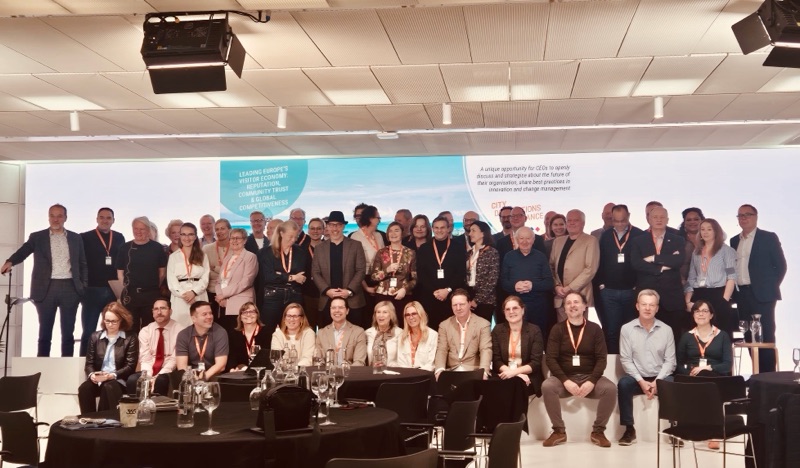
CityDNA CEO Summit, Barcelona
Day 1 reflections: reputation, trust, and the uncomfortable middle ground
Day one of the CityDNA CEO Summit in Barcelona set a clear tone early on.
The opening framing by the CityDNA leadership and hosts in Barcelona made that explicit. Cities are operating in turbulent conditions where tourism is no longer judged only by its economic contribution, but by how it shows up in everyday urban life.
Global turbulence, local consequences
The keynote from WTTC reinforced something many of us already sense intuitively: global tourism performance cannot be separated from geopolitics, climate pressure, social licence, and institutional trust. What was particularly relevant from a city perspective was the emphasis on reputation as a form of resilience. Destinations that lose credibility with residents, policymakers, or international partners become fragile very quickly, regardless of demand curves or connectivity statistics.
What struck me was how closely this global framing aligned with what followed in the CEO workshop. Different cities, different political systems, but very similar tensions. Tourism is visible, easy to blame, and rarely well understood in political debate. Visitors do not vote, residents do. That imbalance shapes decisions in ways that are not always rational or evidence-based.
The small-group workshop was intentionally practical. What emerged was less about solutions and more about alignment. There was broad agreement that DMOs cannot carry challenges alone, yet are often the only actors positioned to convene across silos.
One insight stood out. Trust-building with communities is not a campaign phase, it is an operating mode. Transparency with data, early engagement, and visible trade-offs were seen as more effective than any reactive communication once tensions surface.
Reputation under pressure is not a communications problem
The CEO exchange on reputation was one of the most honest conversations of the day. What emerged clearly was that reputation challenges are rarely solved through messaging. They are structural. Housing, mobility, labour conditions, crowding, and climate impacts all sit outside the traditional comfort zone of DMOs, yet they define how tourism is perceived.
Several contributors acknowledged that the skill set now required of destination leaders looks very different from even ten years ago. Data literacy, mediation between stakeholders, and the ability to translate complex impacts into plain language for residents have become core leadership competencies.
Case studies: Paris and Barcelona as mirrors, not models
The case studies from Paris and Barcelona were not presented as blueprints to copy, but as lived experiments with mixed results.
What resonated most from Paris was the evolving role of the DMO as a neutral intermediary. Acting as a third party between politics and residents, using data to de-escalate narratives, and being present in neighbourhood-level conversations was described not as optional, but necessary. The shift away from traditional visitor information infrastructure toward distributed, partner-based models also illustrated how quickly visitor behaviour is changing, and how uncomfortable adaptation can be.
Barcelona’s contribution was more confrontational, and rightly so. The long-term citizen perception data showed how quickly goodwill can erode when growth is not accompanied by visible reinvestment and limits. The phrase that stayed with me was the central question posed: can tourism save us from tourism? The answer presented was yes, but only through explicit capacity limits, taxation, reinvestment in public goods, and demand management tied to city values rather than volume.
What both cases shared was an insistence that reputation is built through decisions, not slogans.
From words to action: politics, governance, and the EU dimension
The late afternoon session linking the CityDNA Tórshavn Declaration to the wider EU policy agenda pulled the day together. The discussion made it clear that many of the pressures cities face are amplified by the absence of tourism as a serious, structured policy domain at EU level.
The intervention on EU governance highlighted a persistent paradox: tourism is economically significant, socially visible, and politically sensitive, yet institutionally weak. Limited mandates, fragmented responsibility, and a lack of dedicated funding mechanisms continue to undermine long-term resilience. The call for CityDNA to act not just as a network, but as a collective political interlocutor, felt both ambitious and overdue .
Closing the day
By the time the day closed, one thing was clear. European city destinations are no longer debating whether tourism needs to change. The debate is about who leads that change, and with what mandate.
Day 2 reflections: the DNA of cities, trust, and the expanding role of the DMO
If Day 1 was about pressure, legitimacy, and governance, Day 2 was about context and consequence.
Greg Clark’s keynote provided a long arc view that reframed many of the discussions from the previous day. Rather than starting with tourism, he started with cities themselves, and with a proposition that quietly changes the role of destination organisations.
"Cities are not just systems we manage. They are living organisms with DNA."
Greg’s core argument was deceptively simple. Cities have underlying patterns that shape how they evolve, adapt, and respond to shocks. These patterns are not branding exercises. They are rooted in geography, history, social contracts, migration, and the cumulative behaviours of people sharing space over time.
Cities do not thrive by copying each other. They thrive through what Greg described as “customised medicine”. Learning from others matters, but solutions only work when adapted to a city’s own genetic code and epigenetics.
This was particularly relevant in a room full of European cities. Europe’s competitive advantage is not scale or speed, but its network of medium-sized cities with high social capital and deeply layered histories. That social capital comes with a cost. Citizens expect participation, transparency, and a say in how their city evolves. For DMOs, this means the licence to operate is not assumed. It is earned continuously.
From tourism to temporary citizenship
One of the most powerful shifts in the Day 2 discussion was the move away from thinking in terms of “visitors” and toward the idea of users of place.
Greg described cities as moving toward a reality of temporary citizenship. Tourists, students, nomadic workers, seasonal labour, and multi-local residents increasingly use cities without voting in them (being actual citizens). That raises difficult questions about fairness, trust, and governance.
If people shape the city without formal democratic participation, how do we maintain legitimacy with permanent residents? And where does the DMO sit in that equation?
The answer was not that DMOs should take control, but that they cannot remain neutral observers either. The role is increasingly one of convening, framing, and curating, rather than simply promoting.
A line that stayed with me was Greg’s blunt formulation:
"If citizens do not use the city, visitors will not want to visit it."
Tourism demand follows lived experience, not the other way around.
The destination economy and good urbanisation
Another key concept was the destination economy. Tourism is not a standalone sector. It intersects with migration, talent attraction, events, innovation ecosystems, and lifestyle choices.
Greg linked this directly to the idea of good versus bad urbanisation. Cities that curate flows of people, rather than chase volume, build resilience. Cities that fail to align tourism with housing, mobility, labour, and social infrastructure eventually lose trust.
For DMOs, this reframes success. It is no longer measured only in arrivals or room nights, but in whether tourism supports a city’s long-term habitability, innovation capacity, and social contract.
The workshop: listening before deciding
The main workshop of Day 2 used a synodal process, a structured listening method designed to surface convergence rather than reward dominance in discussion. Everyone needed to speak. Everyone needed to listen. Silence was part of the method, not an interruption.
What emerged across the tables was a shared tension.
DMOs are being pushed upward into a helicopter role, expected to see across silos, anticipate risks, and articulate trade-offs. At the same time, mandates and resources often remain narrow, still framed around marketing rather than place management or stewardship.
Several common threads surfaced:
- The need to move from reactive to proactive approaches, especially in cities that do not yet face overtourism but might be heading in that direction.
- The difficulty of explaining place management to political leaders who still see DMOs as promotional units.
- The growing importance of third-party validation and collective European narratives when engaging national governments or the EU.
- A shared frustration that tourism remains structurally under-represented in policy arenas, despite its visibility and impact.
Perhaps most importantly, there was broad agreement that DMOs cannot do everything, but they must help ensure that the right things are done by the right actors. Influence, coordination, and mandate to interact emerged as more realistic and effective than control.
Day 2 did not resolve the questions raised on Day 1. Instead, it sharpened them.
The work of destination organisations is expanding, not because they seek power, but because the conditions for success now sit well beyond marketing. Trust, legitimacy, and social capital are no longer peripheral. They are foundational.
Greg closed with a hopeful proposition. If cities understand and work with their own DNA, rather than against it, we can end up with a more differentiated, resilient, and human-scale urban future. In that future, DMOs help cities curate who comes, why they come, and how they participate, rather than simply how loudly the city is promoted.
That is a demanding role. But after two days in Barcelona, it felt less like mission creep and more like an honest response to the reality cities now face.
Comments