Exploring AI’s Role in Modern Workplaces
This week, I have the privilege of attending a seminar in Oulu that dives deep into the transformative power of artificial intelligence (AI) in businesses and organizations. The event features inspiring speakers, practical use cases, and insightful discussions on how AI is reshaping industries by driving efficiency, fostering innovation, and enhancing employee well-being.
As someone deeply interested in the intersection of AI and workplace transformation, I’m taking notes and summarizing the key takeaways from this seminar. To ensure clarity and depth, I’m leveraging AI tools to help distill the wealth of information being shared. My goal is to highlight the strategies, successes, and challenges that organizations like Fazer and other industry leaders are experiencing as they navigate their AI journeys.
In the posts that follow, I’ll share frameworks, practical tips, and real-world results presented at the seminar, offering a glimpse into how AI is being implemented to solve real business problems. From enhancing employee productivity to creating actionable AI use cases, these insights provide valuable lessons for anyone looking to integrate AI into their organization.
—————
Keynote Summary of Antti Merilehto: Embracing AI in Everyday Work
Introduction: The State of AI Adoption
• AI is transforming industries, but we’re not “too late” to adopt it—there’s still immense potential.
• Tools like ChatGPT have democratized access to AI, enabling both large corporations and individuals worldwide to experiment and benefit.
• The key is not perfection but integration: figuring out how AI fits into your team, organization, and personal workflow.
Foundations of AI: Understanding the Basics
• To work effectively with AI, teams need a shared understanding of the basics. While no advanced degrees are required, everyone should try the tools and experience their potential.
• AI is not a replacement for human expertise but a powerful assistant that can complement and amplify human capabilities.
Practical Applications of AI
1. Efficiency Gains:
• Tasks like generating presentations, graphics, or even writing job applications can now be done in minutes instead of hours.
• AI eliminates “blank page syndrome” by providing starting points, saving time for higher-value work.
2. AI in Business:
• Kaffa Roastery Example: AI helped create a new coffee blend by analyzing sales and flavor data, challenging traditional methods and driving international success.
• Event Design Example: AI tools can provide quick concepts for visual designs, allowing human experts to focus on refining the best ideas.
3. AI for Both Routine and Rare Tasks:
• While AI is often seen as a tool for repetitive tasks, it’s equally valuable for occasional or unexpected needs, such as writing a customer complaint or generating a marketing strategy.
Key Challenges in AI Adoption
• Tool Overload: With thousands of new AI tools released monthly, it’s impossible to keep up. Focus on mastering one tool that fits your organization’s workflow, such as ChatGPT or Copilot.
• Inconsistency in AI Outputs: Tools like ChatGPT can provide different answers to the same query, requiring careful oversight and clear guidance.
Human-AI Collaboration
• Polanyi’s Paradox: Humans know more than they can articulate, and this tacit knowledge is essential for effective AI use.
• AI complements human work by challenging assumptions, sparking ideas, and handling repetitive tasks—but it requires human oversight to succeed.
The Emotional Side of AI
• Change can be intimidating, and fears about AI replacing jobs are common.
• The speaker emphasizes the importance of addressing these emotions, fostering a culture of open discussion, and showing how AI can enhance rather than threaten work.
Call to Action: Start Small, Think Big
1. Experiment: Encourage teams to try AI tools and integrate them into workflows, even if adoption starts with small tasks.
2. Collaborate: AI works best when paired with human insight and creativity.
3. Focus on Customer Value: Use AI to rethink how to deliver better service and experiences for customers.
Closing Message
• AI is not just a trend; it’s a tool that can revolutionize work across industries.
• Success requires humility, curiosity, and collaboration. As explorers in this new frontier, the journey is as important as the destination.
Final Thought: “If you want to go fast, go alone. If you want to go far, go together.”
—————-
Summary of Aki Yrjölä’s Keynote: AI Adoption at Fazer
Overview
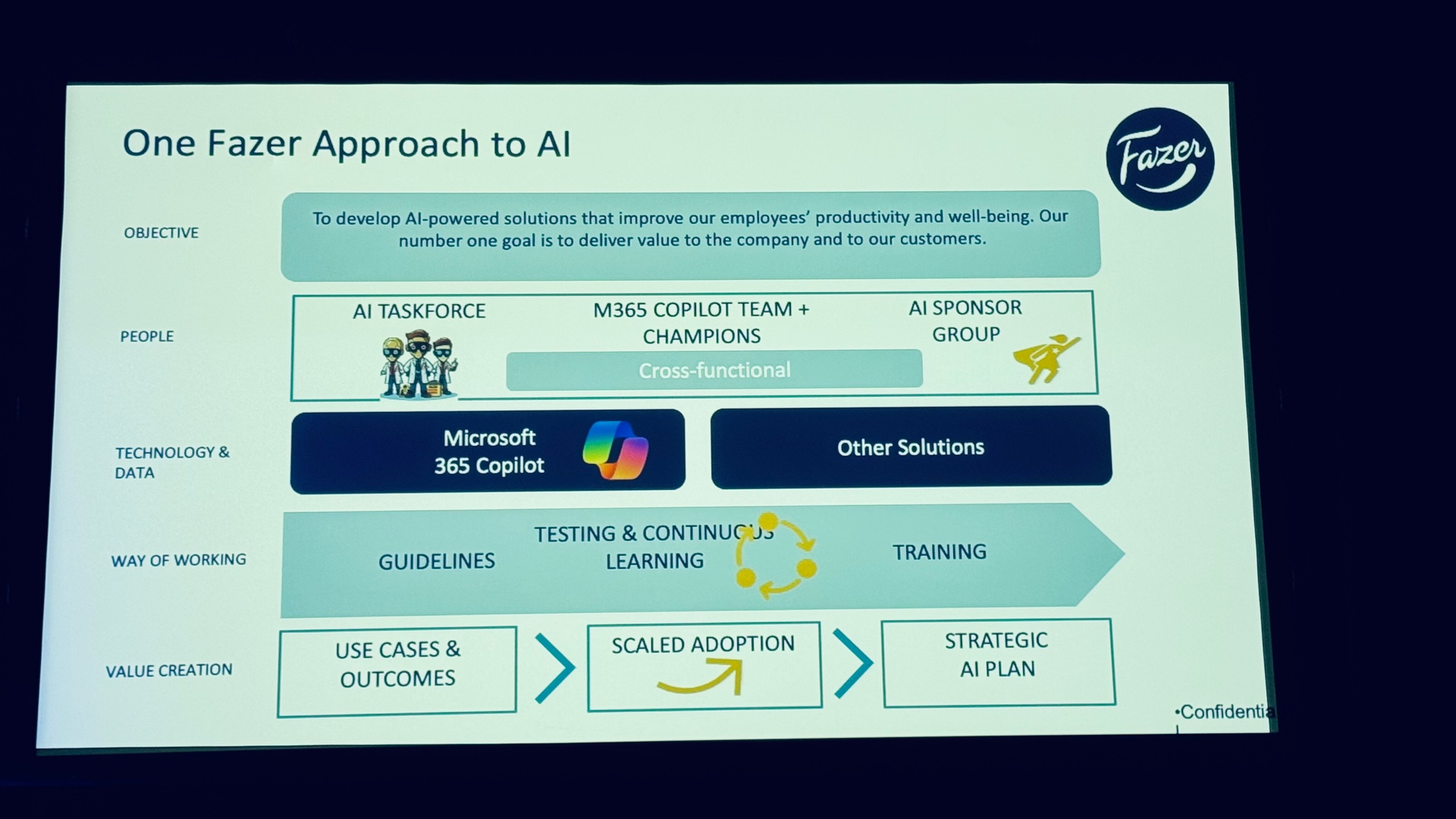
Aki Yrjölä shared Fazer’s journey in adopting AI tools like Microsoft Co-pilot, focusing on tangible benefits, effective implementation strategies, and lessons learned. The keynote highlighted the framework and practices that helped Fazer integrate AI across the organization, emphasizing employee well-being, efficiency, and collaboration.
Key Objectives
• North Star Goal: Improve employee well-being by reducing repetitive work and enhancing efficiency, enabling employees to focus on high-value tasks.
• Balance efficiency with well-being to maintain a sustainable work-life balance.
• Demonstrate AI’s ability to save time and create measurable business impact.
Key Achievements
1. Pilot Results:
• Conducted a 4-month pilot with 300 users across 15 departments.
• Saved 65–100 minutes per user per day, amounting to substantial cost savings (e.g., €500,000 annually for 100 active users).
• High user engagement: 91% active users and 89% satisfaction rates.
2. Strategic Focus:
• Developed 40 AI use cases, with 12 prioritized for implementation.
• Customized AI applications for specific functions like HR, marketing, and finance.
Implementation Framework
1. Extensive Training:
• Over 50 training sessions tailored to roles and tools.
• Deep-dive sessions on specific tools like PowerPoint, Excel, and Co-pilot integrations.
2. Knowledge Sharing:
• Held clinics and workshops to encourage employees to share experiences and insights.
• Created a Super User Champion Network to support internal AI expertise.
3. Continuous Updates:
• Regularly shared new AI use cases, tips, and updates to keep employees engaged.
• Ensured training materials were accessible and function-specific for maximum relevance.
Key Learnings
1. AI Requires Training:
• Simply providing tools like Co-pilot is not enough. Training is essential to unlock its full potential.
2. Tailored Approaches Work:
• Role-specific use cases resonate better than generic examples.
• Functional clinics help employees see direct applications for their work.
3. Collaboration Enhances Adoption:
• Bringing employees together to discuss AI fosters innovation and confidence.
• Inspiration days with external speakers and workshops create excitement and actionable outcomes.
Business Impact
• AI adoption has generated significant time and cost savings.
• Improved employee satisfaction by reducing mundane tasks and enabling more strategic work.
Closing Remarks
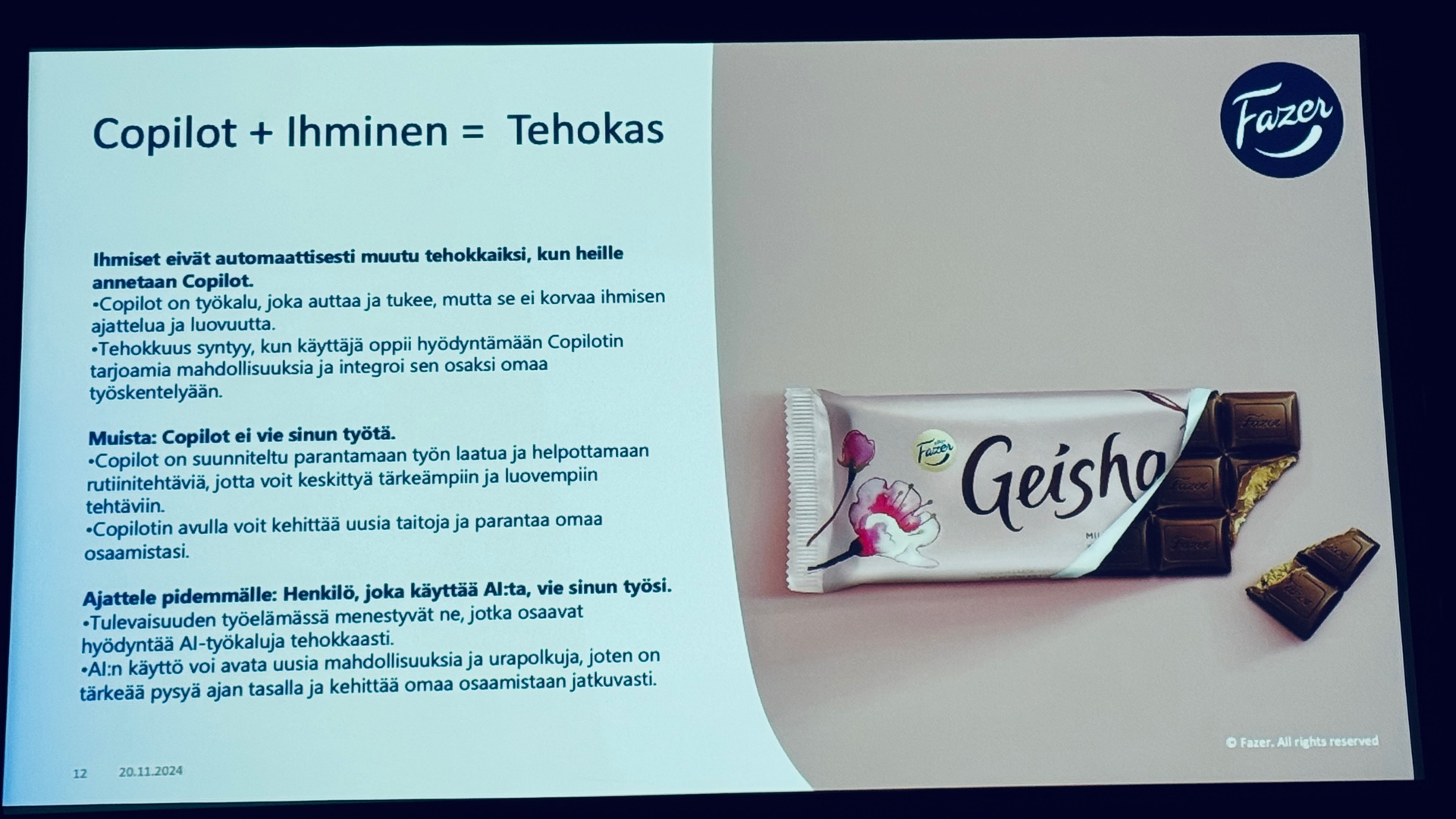
• AI doesn’t replace employees but empowers them to work smarter.
• Companies must foster a collaborative and supportive culture to fully realize AI’s benefits.
• Fazer’s success with AI demonstrates the value of structured implementation, continuous learning, and role-specific applications.
Takeaway: Structured, thoughtful integration of AI tools like Co-pilot can transform organizational efficiency while enhancing employee well-being.
———-
Core Theme: Data is the Foundation for Successful AI
Tommi Vihervaara emphasized that while AI holds immense potential, its success depends entirely on the quality, context, and governance of data. Without strong data foundations, even the most advanced AI systems cannot deliver meaningful or reliable results.
Key Lessons and Takeaways
1. Data is Timeless but Needs Context
• Data Isn’t New: Humans have been collecting and using data for thousands of years, from cave paintings to modern digital systems.
• Metadata is Key: Metadata, or “data about data,” provides the essential context AI needs to interpret and use data effectively.
• Example: The same number could be a player’s jersey number, a ranking, or a phone number, depending on its metadata.
2. Governance is Non-Negotiable
• Organizations must create rules and frameworks for managing data, just as they do for finance, HR, and infrastructure.
• Poorly governed data leads to errors, inefficiencies, and missed opportunities, such as inaccurate customer records or unreliable AI outputs.
3. Invest in People
• Data is created by people, and they need training to ensure it’s high-quality and useful for AI.
• Equip employees with the skills to:
• Use AI tools effectively.
• Produce and maintain clean, accurate, and context-rich data.
• Tommi emphasized that employees without “data” in their job titles often do the most critical data work.
4. Build for the Future
• AI’s true potential will emerge in the next generation, as society adopts the technology and aligns vision with content.
• The groundwork laid today—by investing in data quality, governance, and employee skills—will unlock transformative AI applications in the future.
Key Challenges
1. Data Quality:
• Without proper management, AI may achieve 80% accuracy but fail critically in the remaining 20%.
• Organizations must decide what percentage of their operations they’re willing to entrust to AI’s uncertainties.
2. Data Silos:
• Producers and consumers of data within organizations are often disconnected, leading to inefficiencies and misunderstandings.
• Collaboration and shared understanding are vital.
Actionable Takeaways
1. Establish and enforce data governance rules.
2. Invest in metadata management to provide context for AI.
3. Train employees to produce, maintain, and use data effectively.
4. Treat data as a strategic asset, with the same importance as financial or physical resources.
Final Thoughts
Tommi concluded with a vision for the future, likening the AI revolution to past technological breakthroughs, such as the printing press. By taking data seriously and preparing for AI’s integration today, organizations can unlock unprecedented potential in the coming decades.
Key Message: “Invest in your people and data now—because AI’s true potential will depend on what you do today.”
—————
Core Theme: Leadership as the Key to Navigating AI Transformation
Heidi Kananen highlighted the critical role of leaders in adopting and integrating AI within organizations. Her message centered on the need for courage, strategic foresight, and a people-first approach to overcome challenges and maximize AI’s potential.
Key Lessons for Leaders
1. Holistic Process Optimization
• Optimizing one part of a process without considering the entire workflow can create bottlenecks or inefficiencies.
• Leaders need a big-picture perspective to ensure process improvements align with overall organizational goals.
2. Address Resistance and Emotional Barriers
• Employees often resist AI due to fears of losing control, skepticism about its effectiveness, or discomfort with change.
• Solution:
• Create open dialogue to address fears and uncertainties.
• Emphasize how AI supports—not replaces—their work.
3. Encourage Experimentation and Learning
• Build a culture that supports experimentation, embraces failures, and learns from them.
• Key Actions:
• Provide training and development opportunities to increase AI literacy.
• Foster collaboration to make change a collective effort.
4. Embrace Change with Courage
• The pace of change demands bold decisions to keep up with evolving business needs.
Key Challenges in AI Adoption
2. Resource Constraints: Organizations must achieve more with fewer resources, making AI a necessity.
3. Emotional Resistance: Fear and uncertainty among employees need to be addressed with empathy and communication.
4. Time Pressures: The perceived lack of time to explore AI solutions can hinder adoption.
Actionable Takeaways
2. Foster a Learning Culture: Train teams and encourage them to experiment with AI tools and strategies.
3. Collaborate: Work with employees to address challenges and share successes, building trust and momentum.
4. Be Proactive: Start small but act decisively to test and implement AI solutions.
Final Thoughts
Heidi’s keynote was a call to action for leaders to embrace the transformative power of AI with courage and foresight. She emphasized that while challenges exist, this is a unique opportunity to shape the future and lead organizations into a new era of efficiency and innovation.
Key Message: “AI will transform the way we work. Leaders must be brave, curious, and proactive to guide their teams and organizations through this exciting change.”
Summary of Karoliina Partanen’s Keynote: Accelerating AI Adoption in Finnish Businesses
Karoliina Partanen, leader of AI Finland, delivered an inspiring keynote focused on the current state of AI adoption in Finnish businesses and the steps needed to accelerate its development. Her presentation emphasized AI’s transformative potential for industries and the critical role of leadership in driving successful implementation.
The Role of AI Finland
• Purpose: AI Finland, an initiative by the Finnish Technology Industries, is designed to enhance AI adoption and foster innovation across businesses.
• Support for Businesses:
• Financial grants for AI projects (€50,000) and thesis research (€20,000).
• Open networking platform with over 400 companies involved in AI-focused discussions and initiatives.
• Vision: Establish Finland as a global leader in AI maturity by improving productivity, fostering innovation, and helping traditional businesses transition into tech-driven enterprises.
AI as a Paradigm Shift
• Karoliina highlighted AI as a fundamental shift akin to the digital revolution, poised to reshape industries and society.
• Growth Opportunities:
• Beyond improving internal productivity, businesses must leverage AI for strategic innovation and competitive advantage.
• AI enables entirely new business models, paving the way for sustainable growth and differentiation.
Challenges to AI Adoption
1. Leadership Understanding:
• Leaders often lack awareness of AI’s possibilities and limitations.
• Misalignment between AI initiatives and business strategy hampers success.
2. Data Quality and Governance:
• Poor data quality and unclear data ownership are significant barriers.
• Organizations must focus on building robust data governance structures.
3. Cultural Resistance:
• Employee hesitation and fears about AI replacing jobs slow adoption.
• Leaders must address these concerns with transparency, training, and clear communication.
Strategies for Success
1. Leadership Alignment:
• AI initiatives must be driven by leadership with a clear understanding of AI’s strategic role in achieving business goals.
2. Systematic Innovation:
• Establish processes to identify, evaluate, and execute AI-driven innovations.
• Prioritize projects that align with long-term strategic objectives.
3. Collaboration and Training:
• Foster collaboration across departments to break silos and drive adoption.
• Invest in employee training and reskilling to build trust and competency in AI technologies.
4. Empowering Organizations:
• Create systems that make data accessible, actionable, and secure to support AI initiatives.
• Encourage curiosity and experimentation to build a culture of innovation.
Call to Action
Karoliina urged leaders to adopt a proactive mindset, leveraging AI not just for operational efficiency but as a driver for strategic innovation and growth. She concluded by emphasizing the need for companies to collaborate, experiment, and embrace the transformative potential of AI to remain competitive in the global landscape.
Comprehensive Summary of Daniel Hulme’s Keynote: The Present and Future of AI
Daniel Hulme, Chief AI Officer of WPP and CEO of Satalia, provided a captivating keynote outlining the current state, challenges, and future potential of artificial intelligence (AI). His talk spanned from practical applications to profound societal impacts, offering a detailed framework for understanding and leveraging AI in business and beyond.
AI’s Evolution and Current Capabilities
• Early AI Attempts: Initial efforts in AI focused on rule-based systems to infer knowledge but faced limitations in scalability and applicability.
• Modern AI Models: Current AI systems, such as large language models (e.g., ChatGPT), excel in representing and communicating knowledge but are limited in predictive accuracy and solving complex decision-making problems.
• AI Applications in Business:
• Enhancing productivity through task automation (e.g., email writing, creating presentations).
• Disrupting industries such as advertising, content creation, and customer engagement.
• Improving supply chains and driving digital transformation in sectors like manufacturing and energy.
Six Applications of AI
Daniel highlighted six primary areas where AI creates value:
1. Task Automation: Automating repetitive, rule-based tasks with simple algorithms.
2. Content Generation: Generating brand-specific, differentiated, and production-grade content.
3. Human Representation: Using AI to create digital twins for employees, customers, and audiences to understand and predict behaviors.
4. Pattern Recognition: Extracting actionable insights from vast datasets to enhance decision-making.
5. Complex Decision-Making: Solving large-scale optimization problems, such as workforce allocation or supply chain management, which are beyond human capacity.
6. Human Augmentation: Employing AI to amplify human potential, including using digital twins to guide resourcing and career development.
The Six AI Singularities
Daniel introduced six societal “singularities” that AI could bring:
1. Political: When misinformation undermines trust in truth.
2. Environmental: When AI inadvertently accelerates ecological collapse.
3. Social: When medical advancements lead to curing death and rethinking human mortality.
4. Technological: The creation of superintelligence, surpassing human cognitive abilities.
5. Legal: The rise of ubiquitous surveillance and its implications for privacy and control.
6. Economic: The automation of most paid labor, forcing a re-evaluation of work and societal structures.
Ethics, Governance, and Risks
• Ethical Considerations:
• AI lacks intent, so human oversight is critical in ensuring ethical use.
• The goal should be aligning AI systems with human values to avoid unintended harm.
• Explainability:
• Transparent algorithms are vital for trust and accountability.
• Explainable AI mitigates risks and enables responsible deployment.
• Overachievement Risks:
• AI systems achieving goals too effectively may cause unintended societal harm (e.g., optimizing marketing to exacerbate bias or inequality).
Future Opportunities and Challenges
1. Innovation and Disruption:
• AI presents opportunities to create new business models and industries.
• Examples from leading companies, such as Kone’s predictive maintenance and IceEye’s satellite data services, illustrate the transformative potential of AI.
2. Human-Centric Technology:
• Digital twins for employees can optimize career development and resource allocation while promoting fairness.
• In marketing, understanding and engaging with AI-driven consumer behavior will become increasingly critical.
3. Societal Repercussions:
• Widespread automation may lead to job displacement and social unrest.
• New societal structures, such as universal basic income or four-day work weeks, may be necessary to address these changes.
Key Takeaways for Leaders
• Focus on strategic applications of AI, not just productivity improvements.
• Build the right infrastructure to support data collection, model development, and ethical governance.
• Embrace innovation by fostering a culture of experimentation and collaboration.
• Prepare for a future of abundant resources and redefined work, where AI enables humans to focus on creativity, purpose, and societal contributions.
Daniel concluded with a thought-provoking question: What would you do if you didn’t have to work for money and everything was free? This reflects his vision of a future where AI fosters abundance, empowering humanity to thrive in entirely new ways.

Comments